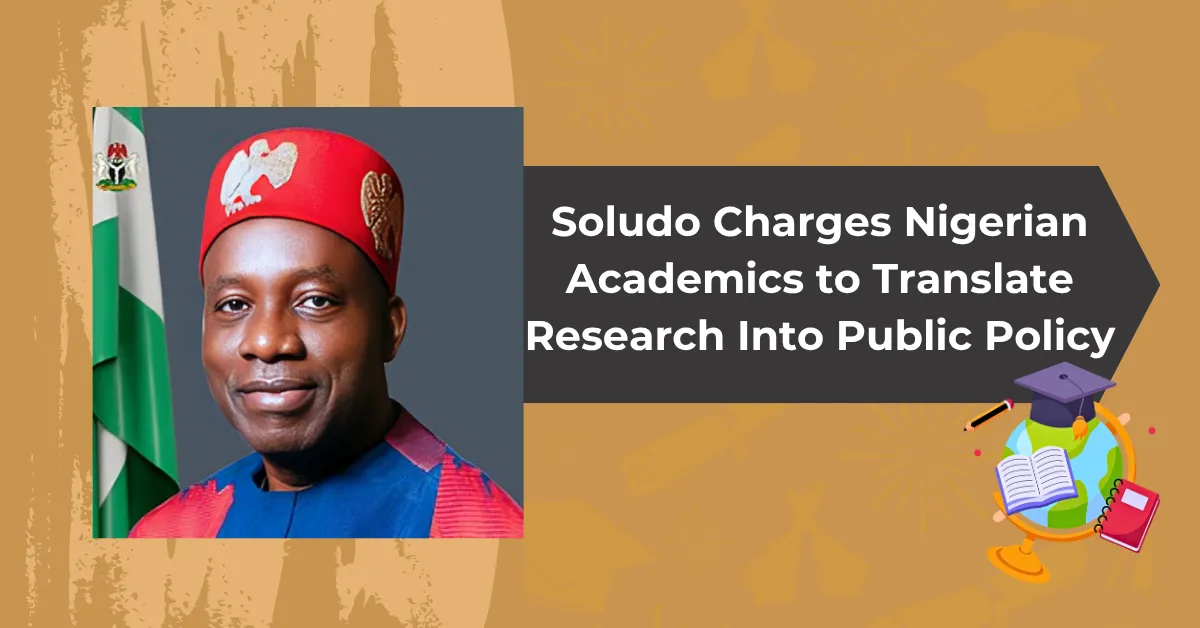
Anambra State Governor Professor Charles Chukwuma Soludo has challenged Nigerian academics to move beyond passive teaching and embrace what he described as developmental intellectualism, urging them to channel scholarly work into practical solutions that shape governance and national development.
Soludo delivered the charge on Tuesday while presenting a lecture at the 6th Biennial Adada Lecture Series organised by the Association of Nsukka Professors (ANP) at the University of Nigeria, Nsukka (UNN).
He lamented the widening gap between academic research and public policy, noting that despite the growing number of scholars in the country, their influence on governance had diminished considerably.
"We are in a period of more noise but less light, where the link between intellectual change and government policy has been severed," he stated.
Soludo invoked the enduring influence of historical figures such as Isaac Newton, Dr Nnamdi Azikiwe, and Kwame Nkrumah to declare that nations are fundamentally shaped by the fusion of ideas and deliberate action. He asserted that natural resources alone cannot build nations without intellectual frameworks to drive institutional development.
The governor challenged scholars at the event to critically assess the impact of their expertise on their immediate communities, questioning why the Adada zone had yet to record significant development despite producing a large concentration of professors.
He described intellectualism without activism as sterile and advocated what he termed "sacrificial volunteerism," urging professors to contribute actively to solving collective challenges regardless of institutional constraints.
Soludo also addressed regional concerns, touching on state creation, marginalisation, and the agitation for Biafra, calling on academics to provide rigorous intellectual leadership on such sensitive matters. He expressed concern over the limited volume of academic research on the Nigerian Civil War within UNN, noting the historical significance of the Nsukka auditorium during that period.
He reiterated his conviction that the interests of the Igbo people were best served within a united and functional Nigeria, and urged intellectuals to lead conversations that would advance the South East and the country as a whole.
Earlier, UNN Vice Chancellor Professor Simon Ortuanya described Soludo's visit as a homecoming and commended his contributions to national development.

Leave a Reply