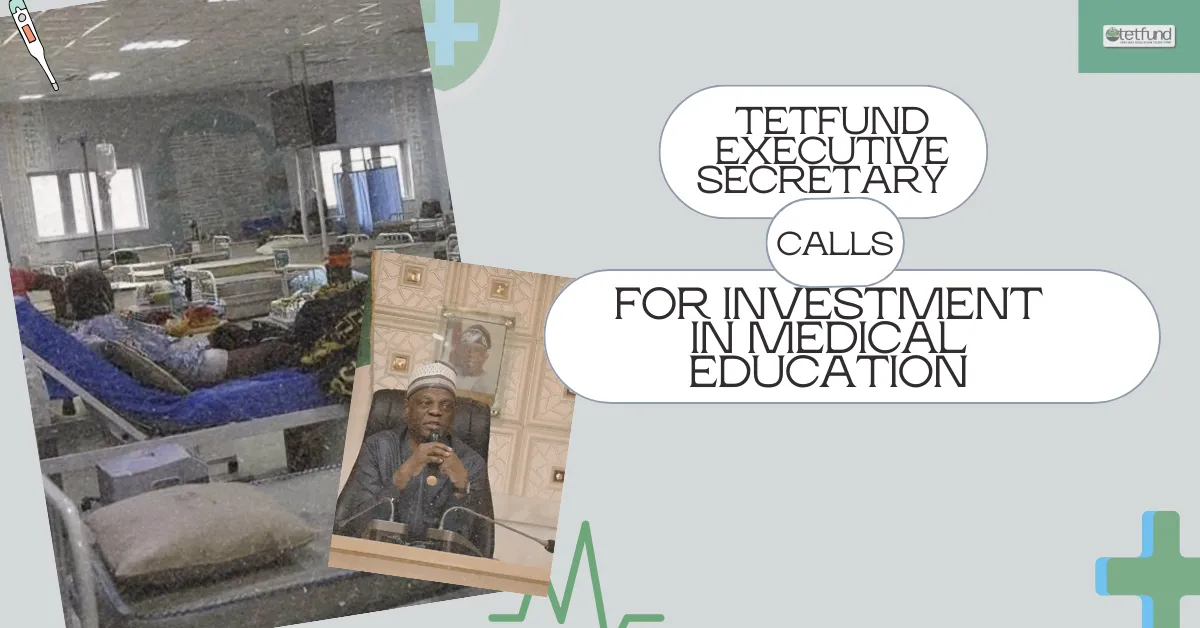
Nigeria's persistent reliance on foreign healthcare could be drastically reduced if the country invests more strategically in medical education and healthcare infrastructure, the Executive Secretary of the Tertiary Education Trust Fund has said.
Sonny Echono made the call on Tuesday in Abuja during a courtesy visit by the Chief of the Air Staff, Sunday Aneke, and a delegation from the Nigerian Air Force to TETFund headquarters.
Mr Echono stated that the federal government had directed relevant agencies to prioritise investments in medical education and healthcare infrastructure to discourage Nigerians from seeking treatment abroad.
He emphasised that the approach includes improving the facilities used to train medical professionals and expanding the capacity of hospitals that provide public healthcare.
"We should significantly improve the facilities available, not only for the teaching of the four core medical courses, medicine, pharmacy, nursing and dentistry, but also for the provision of healthcare for our teeming population," he said.
Nigeria loses approximately $2 billion annually to outbound medical tourism, according to the Nigerian Medical Association, with many citizens and political elites seeking specialised care in countries such as the United Kingdom, India, the United States and the United Arab Emirates.
The Association noted that while developed countries frequently recruit Nigerian trained doctors, many political leaders travel to those same countries for medical care that could potentially be provided locally if facilities were adequately equipped.
Data from the Central Bank of Nigeria shows that Nigerians spent about $3.82 million on foreign healthcare related services in 2023, down from $9.06 million in 2022. The figure declined further to about $2.41 million in 2024, representing a 36.9 per cent reduction compared with 2023.
Experts said the drop may be partly linked to foreign exchange restrictions and rising travel costs, rather than to significant improvements in domestic healthcare services.
Mr. Echono revealed that TETFund is extending its interventions beyond university medical faculties to teaching hospitals to improve clinical training.
"When our students go for their clinical training, they will have accommodation within those teaching hospitals. We are also providing medical equipment across the board," he said.
He added that the Country must also address shortages in other healthcare professions that support doctors within the medical system. "At the top of the pyramid, we have medical doctors, but others provide critical support services. The question is how we can significantly increase the numbers in those relevant supporting fields," he stated.
During the visit, the Chief of the Air Staff, Mr. Aneke, acknowledged that the Fund's interventions in the Air Force Institute of Technology have been remarkable and impactful over the years. He appealed to TETFund for intervention at the Nigerian Air Force School of Medical Sciences and Aviation Medicine.
"The school will not only cater to the Nigerian Air Force but will also serve our civilian counterparts," he said.
With TETFund now extending its reach beyond traditional academic facilities to include teaching hospitals and specialised medical training institutions, the agency is positioning itself as a critical player in Nigeria's efforts to build a healthcare system capable of retaining both its professionals and its patients.


Leave a Reply