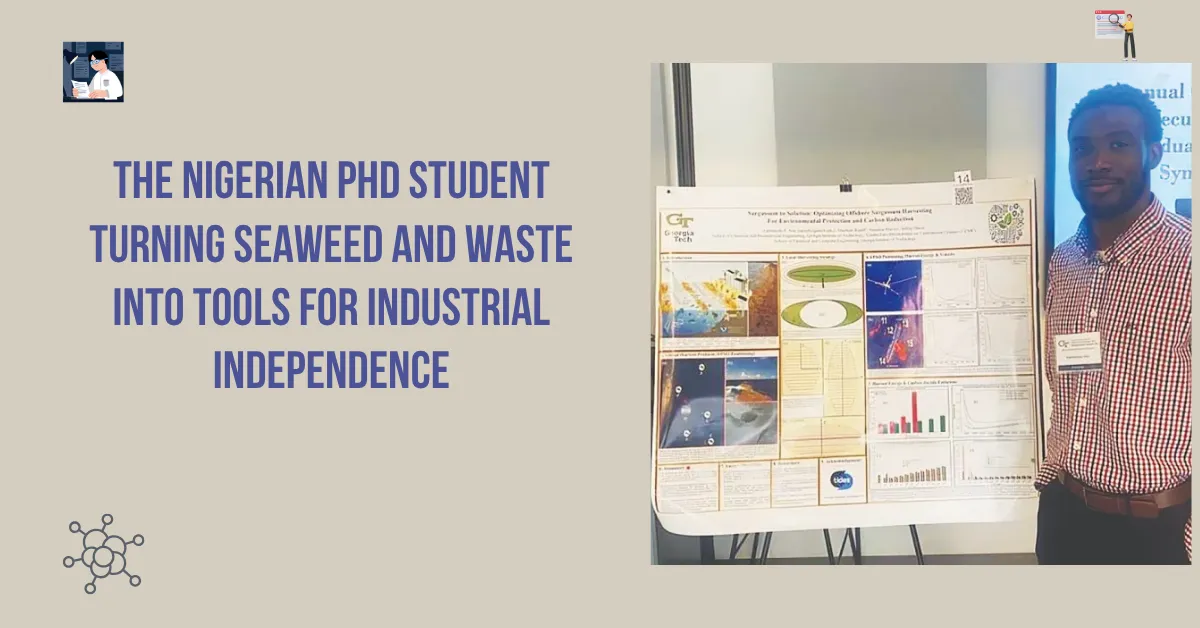
A Nigerian Doctoral Student is producing research that could have direct consequences on how Nigeria and other developing nations manage environmental waste, generate clean energy, and reduce dependence on imported industrial chemicals, yet his story remains largely unknown at home.
Aderinsola Aliu, a PhD student in Chemical and Biomolecular Engineering at the Georgia Institute of Technology, is working at the intersection of data science, optimisation, and chemical engineering to develop computational models for some of the world's most stubborn environmental problems. His research covers carbon sequestration, renewable fuel production, and circular bioeconomy systems, areas of growing urgency for a country like Nigeria where environmental degradation, fuel dependency and industrial underdevelopment remain unresolved challenges.
Using optimisation tools built in Python and PYOMO, Aliu has developed frameworks for converting biomass using black soldier fly larvae into renewable biofuels and for modelling ocean based carbon capture systems. He has also examined how sargassum seaweed, which chokes coastlines across the Gulf of Guinea and causes significant economic damage to fishing communities, can be transformed from an environmental hazard into a commercially viable bio resource.
Aliu studied Chemical Engineering at the University of Lago. The grounding he received there in mathematical modelling and computational approaches to chemical processes formed the basis of his doctoral work and represents the kind of return on investment that Nigerian Universities rarely get credit for producing.
What makes Aliu's work relevant beyond academia is its potential application. The technologies he is modelling, if developed and transferred back to Nigerian Institutions, could offer practical pathways for converting agricultural waste into fuel, cleaning up coastal pollution, and reducing the import burden on Nigeria's foreign reserves, outcomes that a country of Nigeria's resource profile has every reason to pursue.
For Nigerian University students, his trajectory raises an uncomfortable but important question about what becomes possible when foundational University training meets adequate research infrastructure, and what Nigeria continues to lose when that infrastructure remains out of reach.

Leave a Reply