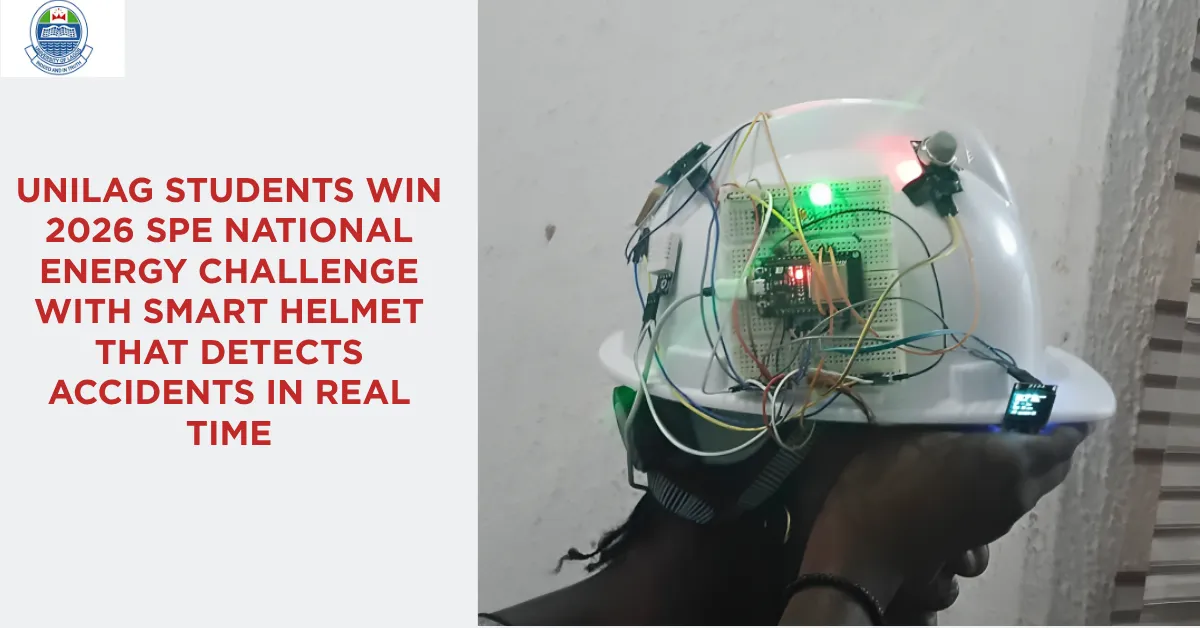
Academic competitions rarely produce something genuinely useful. The team that walked away with first place at the 2026 Society of Petroleum Engineers Student Technical Symposium and Exhibition built something that could save lives on an oil rig.
Nine students from the University of Lagos outperformed eight competing universities at the event, held at the Petroleum Training Institute in Warri, Delta State, from 26 to 28 March 2026, winning the National Energy Challenge with a device they called the Smart Helmet: an IoT based wearable that monitors a worker's health in real time, detects hazards and triggers emergency alerts without human intervention.
The helmet incorporates a pulse rate sensor capable of identifying sudden spikes that may signal an accident or health crisis, automatically notifying Health, Safety, and Environment personnel the moment a threshold is crossed. An accelerometer built into the device detects falls, a critical feature for workers operating at height on industrial structures in the oil and gas and construction sectors, where delayed response to emergencies costs lives.
The winning team drew from five different departments across the university, bringing together students of Petroleum and Gas Engineering, Mechanical Engineering, Computer Engineering, Physics, and Petroleum Engineering. The members are Ogboro Olaoluwa Samuel, Adegboye Kehinde, Chi Ife Ileka, Uko Samuel, Kenneth Silva Eboagwu, Odujirin Boluwatife, Ajah Raphael, Udomeh Gerald, and Adegoke Precious.
The SPE Student Technical Symposium and Exhibition is an annual platform for Nigerian engineering students to present solutions to real industry problems before professional judges. In a competition where theoretical elegance often wins over practical application, UNILAG's entry stood out because it addressed a specific, documented failure in Nigeria's energy sector: the gap between when an accident happens and when help arrives.
Leave a Reply