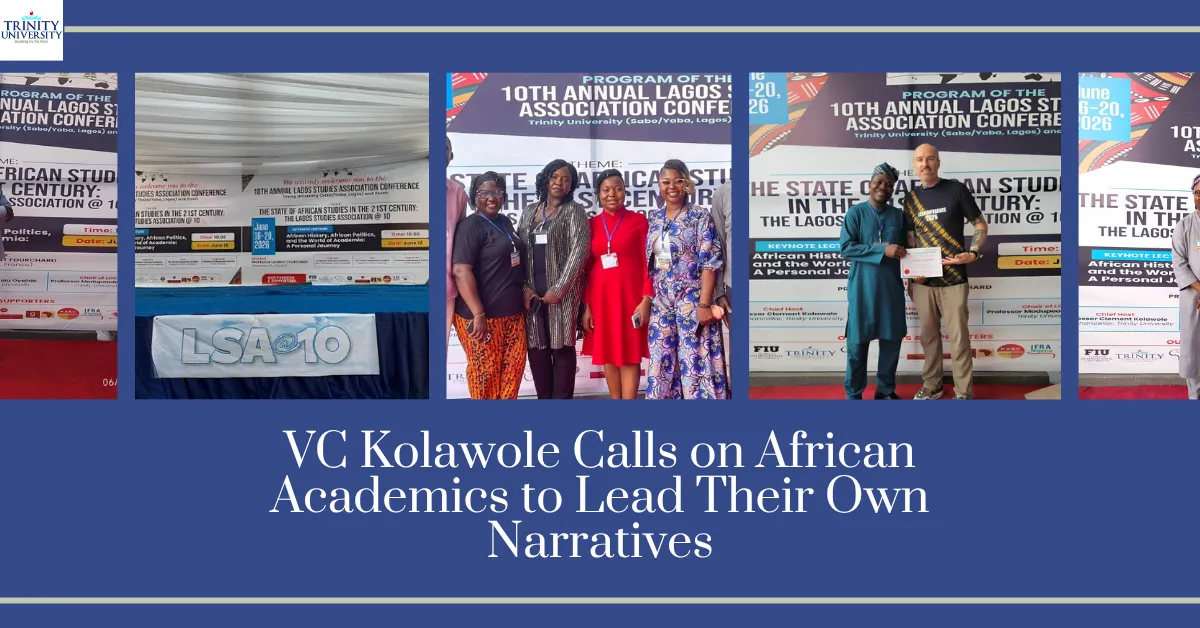
The Vice Chancellor of Trinity University, Yaba, Lagos, Professor Clement Kolawole, has urged African scholars to take deliberate ownership of how Africa is represented in global academic discourse, warning that the continent's stories will remain untold if its own academics do not tell them.
Kolawole made the charge at the opening ceremony of the 10th annual conference of the Lagos Studies Association, hosted by the University. The conference, attended by academics and non academics from around the world, was themed "The State of African Studies in the 21st Century."
"If Africans do not tell their stories, no one will," Kolawole stated, adding that the university would partner with the association to advance African scholarship. He also pushed back against earlier calls by a former Nigerian administration to scrap humanities programmes, arguing that the discipline remains central to nation building.
LSA President Professor Saheed Aderinto, who co founded the association, noted that it had grown from a 10 panel conference into a 340 panel affair. "We are building knowledge systems that place Africa at the centre of intellectual production," he stated, thanking scholars, students and practitioners who had sustained the association over the years.
Professor Paul Obi Ani of the University of Nigeria described LSA's evolution from a loose gathering into a structured movement, noting that it now runs programmes including scholarships for young academics. "I encourage the academics to replicate this beyond Lagos," he said.
Director of the French Institute for Research in Africa, Pauline Guinard, described LSA as a space to build, grow and share knowledge, while University of Ibadan Professor Mutiat Oladejo called it "a marketplace for the humanities."
The conference's keynote address was delivered by Professor Laurent Fouchard of Science Po, France, who presented research on agberos, commonly described as street urchins, in Lagos. Fouchard challenged that characterisation before attendees, arguing that agberos represent an organised and widely misunderstood group with genuine contributions to the urban economy. "We can't reduce the agberos to criminals. They have a lot to contribute to Nigeria," he submitted.
Leave a Reply