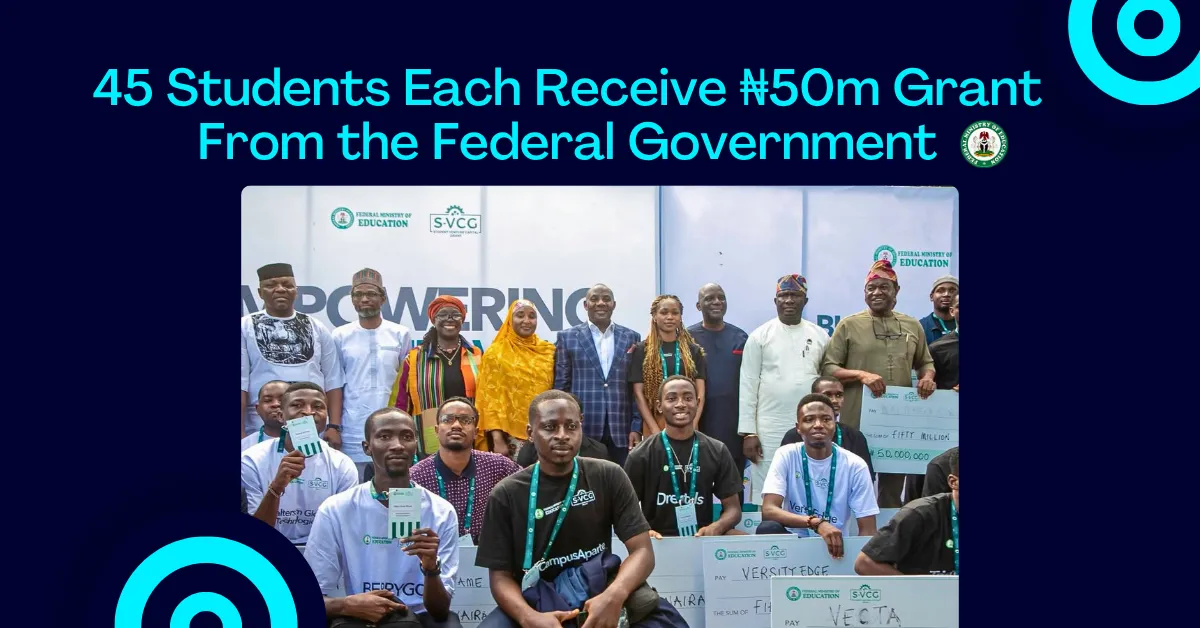
From a pool of over 30,000 applicants drawn from more than 400 tertiary institutions across the country, 45 student led teams have emerged as beneficiaries of the Federal Government's Student Venture Capital Grant, receiving ₦50 million each to transform their campus innovations into scalable businesses capable of addressing real national challenges.
The grants were unveiled at a ceremony held at the United Nations Development Programme (UNDP) Innovation Hub in Ikoyi, Lagos, marking the final stage of a programme that saw 65 finalists complete a rigorous three day bootcamp before pitching their innovations before a panel of industry experts.
The Minister of Education, Dr Tunji Alausa, described the initiative as a bold declaration that the next wave of global innovation would be driven by Nigerian youth, stressing that the government is deliberately shifting focus from certification based learning to innovation driven education. "For too long, our tertiary institutions have been seen primarily as centres for certification. Our institutions must now become centres of innovation, engines of enterprise and launchpads for global solutions," he stated.
Alausa added that beyond funding, the programme provides equity free grants, structured incubation, mentorship and access to cutting edge digital tools to support beneficiaries in scaling their innovations. He acknowledged partners, including UNDP, Google and the Bank of Industry, for their support in expanding opportunities for student innovators.
"Today is not just another programme event. Today, we are activating a new future and a new vision for Nigerian students. Great ideas should not die in classrooms but be nurtured into impactful solutions for our society," Alausa added. He further urged universities to move beyond teaching to become innovation hubs driving national development through research, commercialisation and technology transfer.
The Minister of State for Education, Professor Suwaiba Sa'id Ahmad, described student entrepreneurship as a critical national strategy for job creation, innovation and economic growth, congratulating the finalists for demonstrating creativity, resilience and problem solving abilities. "It is not enough for students to acquire academic knowledge. They must also be empowered to translate ideas into viable enterprises that create value, generate employment and address societal challenges," she stated.
The Minister of Communications and Digital Economy, Dr Bosun Tijani, commended the Federal Ministry of Education for promoting entrepreneurship and innovation in tertiary institutions, urging students to focus on building sustainable solutions. "Believe in the principle of compounding. Do small things consistently; they accumulate and become meaningful outcomes, creating value, driving innovation, and building inclusive, sustainable impact for society and future generations," he advised.
UNDP Resident Representative Elsie Attafuah described the initiative as a strategic national system designed to connect education, research, innovation and investment, noting that it would help convert ideas into enterprises, enterprises into jobs and jobs into industries.
She urged the beneficiaries to see their grant not as a conclusion but as the beginning of a far more demanding phase, one that requires refining ideas, engaging with the market, and continuously adapting to scale impact.


Leave a Reply