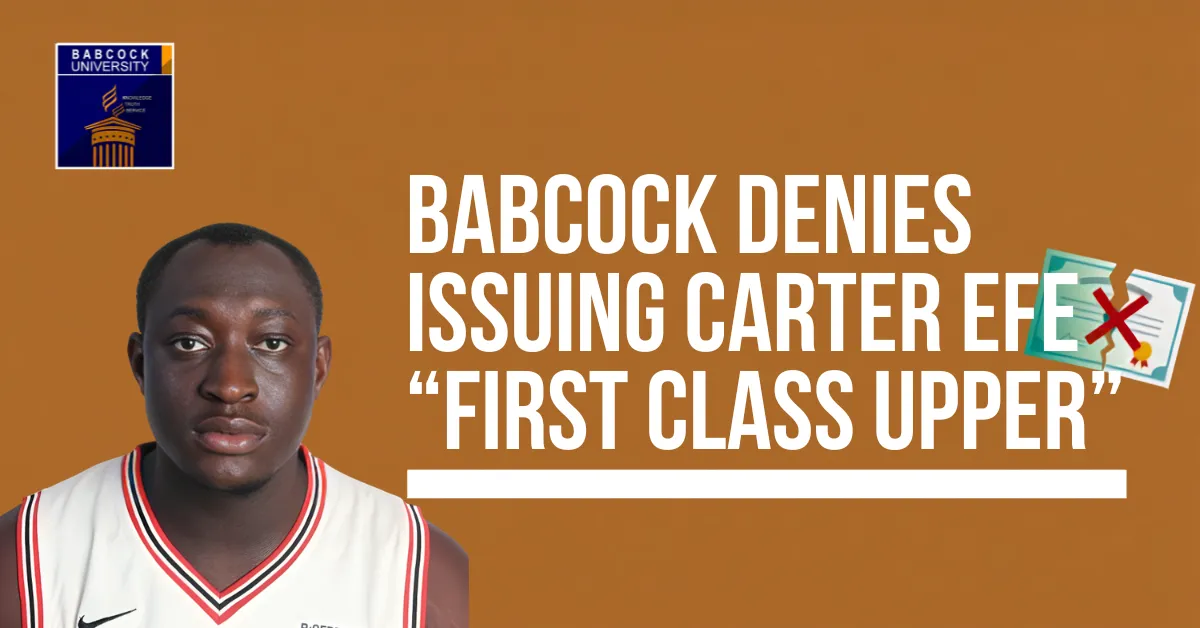
Babcock University has disowned a purported academic certificate claiming that content creator Carter Efe, born Oderhohwo Joseph Efe, graduated with a "First Class Upper" in Biochemistry, describing the document as fraudulent and confirming that legal action against those responsible had begun.
The university issued the warning in a public notice released on Monday and shared on its official X account after discovering the circulation of fake certificates by individuals falsely claiming affiliation with the institution.
The matter arose after Carter Efe told Egungun of Lagos that he had graduated from the private university with top honours, having earlier responded to social media users questioning his educational background. He subsequently shared what he claimed was his 2023 graduation certificate online.
"The attention of Babcock University has been drawn to the circulation of fraudulent documents by certain individuals falsely claiming to have affiliations with, and possessing honorary certificates and academic distinctions purportedly issued by the University," the statement read.
According to the university, the document in question was a purported honorary certificate allegedly issued by the "Babcock University Biochemistry Computer Club" to Oderhohwo Joseph Efe for achieving a "First Class Upper."
"Babcock University unequivocally states that this document is false, unauthorised, and does not emanate from the University," it stated.
The institution clarified that it does not issue honorary certificates in recognition of undergraduate academic performance and that no classification known as "First Class Upper" exists within its academic system.
"There is no academic classification or degree known to Babcock University as 'First Class Upper'. The recognised classification is First Class Honours," the statement read, adding that academic excellence is formally recognised only through the university's official degree certificate and transcript issued by the Office of the Registrar.
Babcock urged employers, schools, government agencies, international organisations and members of the public to disregard the forged document and any similar unauthorised certificates. It warned that anyone who produces, circulates or uses forged academic documents to obtain employment, admission or any other advantage risks investigation and prosecution.
The university further stated that it reserved the right to pursue civil and criminal proceedings against any individual or organisation found to have misrepresented its name, logo, seal or academic credentials.
"The University will not hesitate to pursue all available legal remedies to protect the integrity of its academic credentials and institutional reputation," it said.
Babcock encouraged the public to verify any academic credential bearing its name through the Office of the Registrar before relying on such documents for official purposes.
Leave a Reply