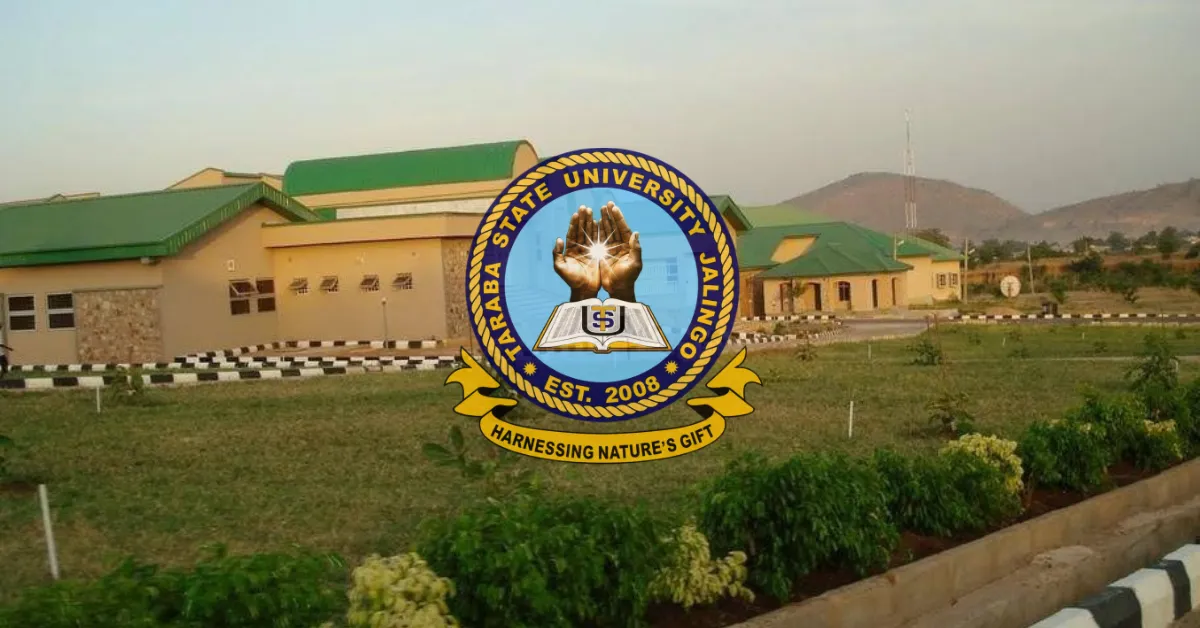
If you are considering studying at Taraba State University (TSU), knowing the available courses and programmes will help you determine whether the institution offers your preferred field of study.
Whether you are interested in the sciences, engineering, agriculture, law, education, management sciences, social sciences, or the humanities, TSU offers programmes designed to prepare students for successful careers and further academic advancement.
TSU Faculties and Departments 2025/2026 Session
TSU runs its academic programmes through ten major faculties, each housing several departments.
Understanding this structure helps prospective students see at a glance where their course of interest falls and what related options exist within the same faculty.
Faculty | Departments |
|---|---|
Faculty of Agriculture | Soil Science, Crop Protection, Animal Science, Agronomy, Home Economics, Agricultural Economics and Extension |
Faculty of Arts | Theatre and Film Studies, Languages and Linguistics, French, Christian Religious Studies, Islamic Studies, Arabic, English and Literary Studies, History and Diplomatic Studies |
Faculty of Communication and Media Studies | Advertising, Journalism and Media Studies, Broadcasting, Public Relations |
Faculty of Education | Vocational and Technology Education, Guidance and Counselling, Library and Information Science, Arts Education, Science Education, Social Science Education, Educational Foundations |
Faculty of Engineering | Electrical and Electronic Engineering, Mechanical Engineering, Civil Engineering, Agricultural and Bio-Resource Engineering |
Faculty of Health Sciences | Nursing Science, Public Health, Environmental Health, Medical Laboratory Science |
Faculty of Management Sciences | Geography, Sociology, Business Administration, Accounting |
Faculty of Law | Law |
Faculty of Science | Physics, Chemistry, Biological Sciences, Mathematics and Statistics, Computer Science |
Faculty of Social Sciences | Economics, Peace Studies and Conflict Resolution, Political Science and International Relations |
This wide faculty spread means candidates interested in everything from engineering and the sciences to the humanities and management can find a relevant programme at TSU.
General Admission Requirements for 2025/2026
Gaining admission into Taraba State University requires candidates to satisfy both the institutional minimums and specific departmental criteria.
Admissions are processed primarily through the Unified Tertiary Matriculation Examination (UTME) and Direct Entry (DE) channels managed by the Joint Admissions and Matriculation Board (JAMB).
UTME (100 Level) Entry Requirements
Candidates seeking entry via the standard UTME path must fulfil the following parameters:
Age Requirement: Applicants must be at least 16 years of age by the time institutional registration begins.
O-Level Credentials: Candidates must possess a minimum of five ordinary level credit passes in Senior Secondary Certificate Examinations (SSCE), National Examination Council (NECO), or National Business and Technical Examinations Board (NABTEB).
These credits must include English language and mathematics, alongside three other subjects relevant to the chosen field.
Sitting Limits: The required five O-Level credits must be obtained in not more than two sittings.
JAMB Cut Off Mark: Applicants must achieve the official minimum institutional cut off mark determined by TSU for the 2025/2026 session, as well as specific departmental baselines.
Direct Entry (200 Level) Requirements
For candidates seeking advanced placement into the second year of study, the university accepts various higher diplomas and advanced certificates:
National Diploma (ND): Obtained from a recognised polytechnic with a minimum score of lower credit.
National Certificate in Education (NCE): Minimum of merit passes in major teaching subjects, specifically for Faculty of Education paths.
Advanced Level (A-Level/IJMB): Successful completion of Interim Joint Matriculation Board or equivalent examinations with relevant point distributions matching the department of choice.
O-Level Sync: Direct entry candidates must still possess the baseline five O-Level credits required of UTME candidates.
Postgraduate and Other Programmes
Beyond undergraduate admissions, TSU also runs postgraduate programmes across most of its faculties, alongside diploma, IJMB, distance learning, and pre-degree programmes.
These alternative pathways are particularly useful for candidates who do not meet direct UTME admission requirements, working professionals seeking part time study options, or those looking to upgrade their qualifications before proceeding to full degree programmes.
Frequently Asked Questions
Q: Are all TSU courses accredited?
A: TSU's undergraduate programmes are approved by the National Universities Commission (NUC), while professional programmes are also subject to accreditation by the relevant regulatory bodies where applicable.
Q: Can I change my course after gaining admission into TSU?
A: Yes. Eligible students may apply for a change of course in accordance with the university's guidelines, subject to meeting the requirements of the new programme and the availability of spaces.
Q: Does TSU offer postgraduate programmes?
A: Yes. In addition to undergraduate programmes, TSU offers a variety of postgraduate diploma, master's, and doctoral programmes through its School of Postgraduate Studies.
Q: Can I apply for more than one course at TSU?
A: No. During the admission process, candidates are expected to apply for one programme. However, applicants who do not meet the requirements for their preferred course may be considered for a change of programme where applicable.
Q: How can I confirm whether my preferred course is available at TSU?
A: You can verify the availability of your preferred programme by checking the official TSU website or the current admission brochure before submitting your application.

Leave a Reply