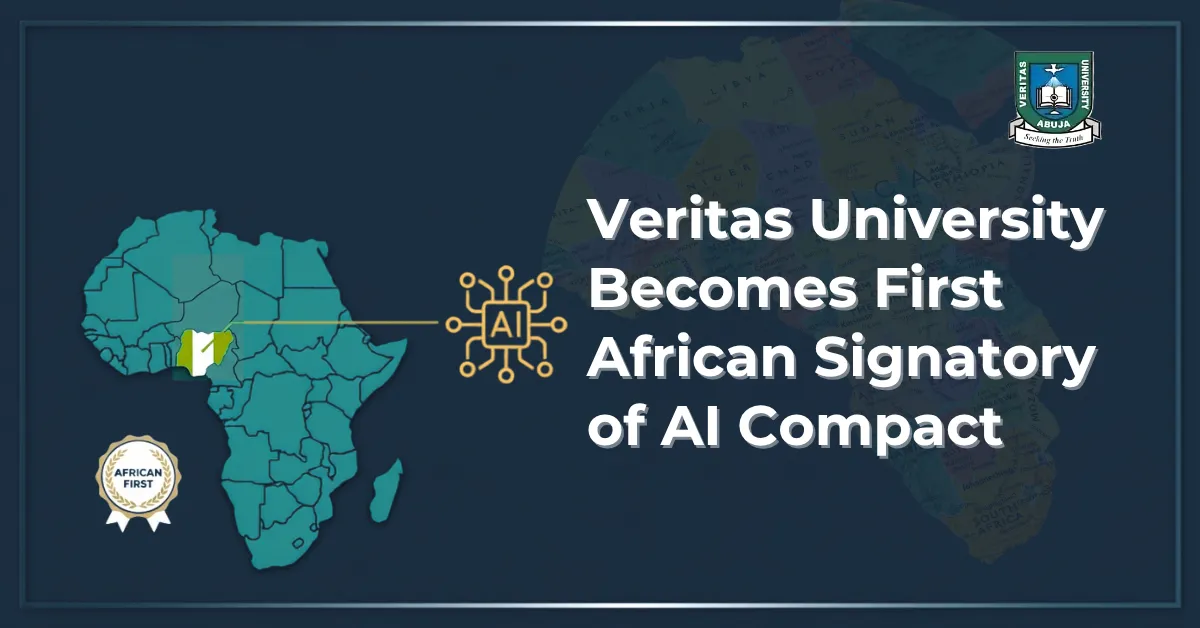
Veritas University, Abuja, has become the first university in Africa to formally commit to ethical artificial intelligence governance, signing the Humanitas AI Compact, a cross sector framework intended to ensure that AI development prioritises human dignity and the common good.
The development was disclosed in a statement issued on Tuesday by the Head of Corporate Affairs and Communications of the university, Ben Agande, who described the signing as the institution's response to the Magnifica Humanitas, a papal declaration by Pope Leo XIV calling on universities worldwide to assume responsibility for the ethical governance of artificial intelligence.
According to the statement, the signing ceremony took place during the 154th Senate meeting of the university, where proceedings were briefly suspended to accommodate the event. Vice Chancellor Prof. Hyacinth Ichoku signed the compact on behalf of the institution, describing the move as a direct response to the papal call for academic institutions to take leadership in shaping the ethical direction of AI.
"The Humanitas AI Compact exists because of Magnifica Humanitas. In Magnifica Humanitas, the Holy Father, Pope Leo XIV, called on universities and institutions of learning by name to take up their responsibility in the age of artificial intelligence. This Compact is our institutional response to that call, beginning from Africa and extending to all institutions entrusted with the formation, protection, education, healing, governance, and advancement of the human person," Ichoku said.
He explained that the papal declaration is rooted in protecting vulnerable populations and promoting inclusive development in the digital age.
"AI must serve humanity: the poor, the sick, the migrant, the displaced by war, women and girls, and all those vulnerable to exclusion, poverty, conflict, sickness, displacement, manipulation, and invisibility," he added.
Ichoku stressed that universities must move beyond academic acknowledgement of ethical frameworks toward active institutional implementation.
"An encyclical is never only a document to be admired. It is a call to be received, embodied, organised, and carried into the world," he said.
Other signatories included Prof. Emeka Aniagolu of the Institute for African American Studies, Abuja; Elder Solomon Appiah Wilson of the Commonwealth Forum, London; Dr Sam Amadi of the Centre for AI, Digital Justice and Economic Rights; and Dr Mehad Nasreldin of the African Institute of Public Health, Addis Ababa.
Under the compact, signatory institutions commit to seven core principles, including human dignity, subsidiarity, the common good and truth, alongside seven key commitments such as reviewing academic programmes for holistic human formation, strengthening digital literacy and prioritising vulnerable populations in AI deployment. The framework also cautions against over reliance on algorithmic decision making in matters affecting human life and dignity.
The statement indicated that the next phase will open participation to a wider network of educational institutions, healthcare providers and civil society organisations across Africa and globally, expected to coincide with the second month of the Magnifica Humanitas declaration.

Leave a Reply