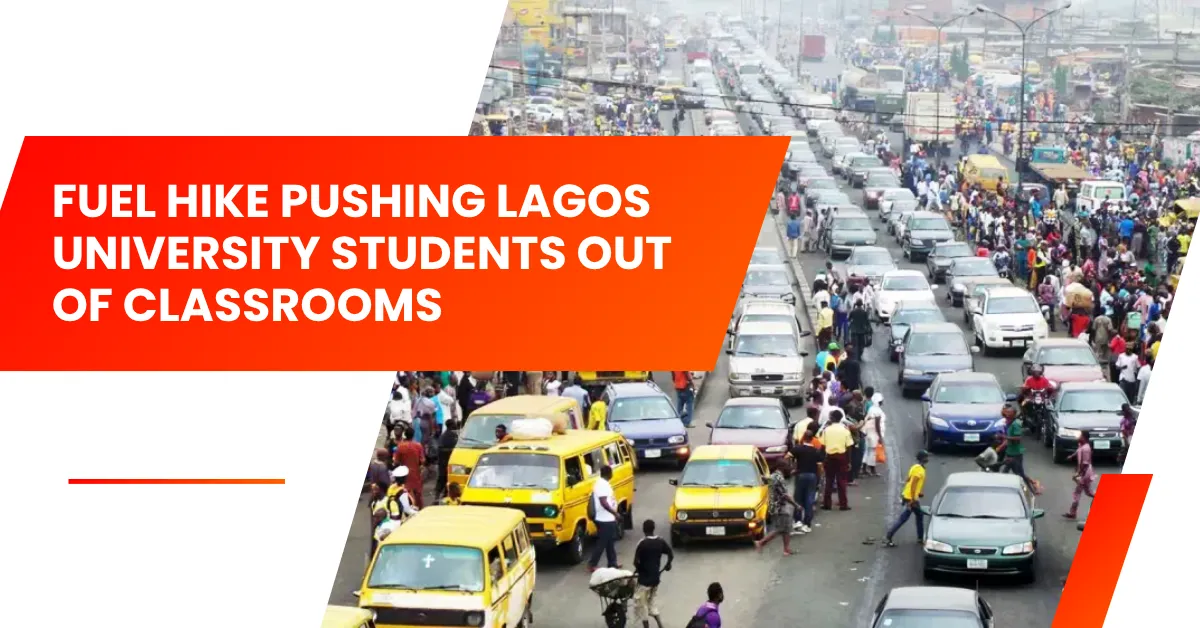
Thousands of University Students across Lagos are at risk of falling behind in their studies as soaring transport costs, triggered by recent fuel price increases, make daily commutes to campuses increasingly unaffordable.
Students, parents, and school operators are complaining that fares across multiple Lagos routes have risen sharply, with many students now skipping lectures, trekking dangerous distances, or rationing their trips to campus in a bid to manage dwindling finances.
At the University level, the situation has reached a critical point. Orobiyi Adefemi, a Student of Lagos State University of Science and Technology, said his transport cost to Ikorodu has jumped from between ₦1,800 and ₦2,000 to ₦3,000. "Because of the fuel price increase, I don't go to school every day like before, and it is already affecting my studies," he said.
Mutiat Tiamiyu, a Student of the University of Lagos, said the crisis has forced her to make impossible choices even during examination periods. "I sometimes avoid taking the campus shuttle so I can save money for my trip back home. There was a day I had to trek to my exam venue because I needed to keep my transport fare," she said. She also recently trekked home after discovering that the fare from Ojuelegba to Shitta had increased without warning.
A trader identified as Mummy Shehu said her sister, enrolled at Yaba College of Technology, previously managed on a daily transport budget of around ₦5,000 but can no longer sustain that figure. "It is really difficult for us," she said.
The crisis extends beyond Universities. Secondary school students reported steep fare increases on their routes, with Simisola of Hezibah College saying her fare rose from ₦100 to ₦300, and Adeshewa of First Choice Academy noting that she and her sister now pay ₦400, up from ₦300. A parent, Mrs. Muritadoh, said fares from Alapere to Oriola have climbed from ₦300 to ₦500. "The government did not increase salaries, yet transport fares keep rising. It is becoming very difficult for parents to cope," she said.
School operators warned that the disruption is now Institutional. Mrs. Ghaniyat, proprietor of Al Ganiyy Academy, said teachers are arriving late alongside pupils as buses become increasingly scarce. "Parents complain that buses are not as available as before due to the fuel hike. Teachers are also affected because transport fares have increased, and sometimes they arrive late to school," she said. The school is now considering a salary review next term to help staff manage rising commuting costs.
Respondents across the board warned that without urgent government intervention, the transport crisis threatens to become a permanent barrier to education for thousands of Lagos students already navigating one of the most expensive cities in Nigeria.



Leave a Reply