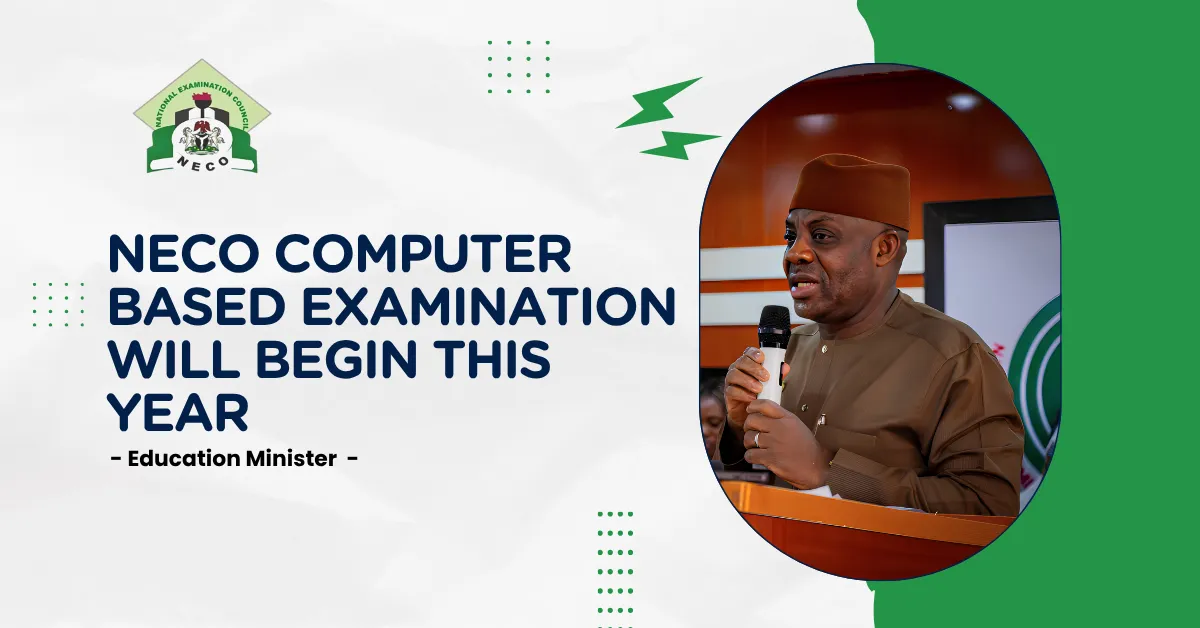
Nigeria's examination system is set for a significant overhaul as the Federal Government announces the introduction of computer based examinations under the National Examinations Council, a reform the Minister of Education says will curb malpractice and position the country's assessment framework for global competitiveness.
Education Minister Dr Tunji Alausa announced NECO's Silver Jubilee celebration held at the Bola Ahmed Tinubu Conference Centre, Garki, Abuja, describing the council as a "standard bearer for credible external examinations" and confirming that the transition would commence within the year.
"We are at the threshold of a very important reform, which NECO is spearheading, and that is the Computer Based Examination, which is to commence this year," Alausa stated. He added that the system would enable real time monitoring of candidates, track suspicious activities and drastically reduce examination fraud that has continued to erode public confidence in national assessments.
The minister noted that NECO's 25 year journey reflected Nigeria's determination to build a credible assessment system capable of guaranteeing equal opportunities for learners across the country. He pledged that the Ministry of Education would continue to provide policy direction to ensure NECO examinations aligned with national curricula and broader development goals, stressing that future assessments must prioritise critical thinking, problem solving and digital literacy over rote learning.
Vice President Kashim Shettima, represented by his Senior Special Assistant on Legal and Compliance Matters, Barrister Bashir Maidugu, commended NECO for embracing digital solutions and aligning with global best practices, while urging the council to ensure its services remained accessible and affordable to every Nigerian child, regardless of background. He called on the council to deepen its commitment to integrity, strengthen security mechanisms, and leverage technology and strategic partnerships, particularly in the era of artificial intelligence.
House of Representatives Speaker Tajudeen Abbas, represented by Deputy Speaker Benjamin Kalu, identified examination malpractice as a direct threat to the credibility of Nigeria's education system, warning that weak credentialing structures undermine merit, fuel distrust, and erode confidence in public institutions. Abbas applauded recent progress recorded by NECO and WAEC in reducing malpractice through biometric verification, tighter supervision, and improved logistics, but stressed that stronger legislative action remained necessary.
"The integrity of national assessment systems is essential to the credibility of educational results, the legitimacy of certifications, and the proper functioning of merit based opportunity frameworks," Abbas noted, adding that the House of Representatives would continue to deploy its constitutional powers of lawmaking, oversight, and appropriation to modernise the country's assessment architecture and strengthen cybersecurity protections.
NECO Registrar and Chief Executive Prof Dantani Ibrahim Wushishi revealed that the council, established in April 1999 under the military administration of Abdulsalami Abubakar, had grown from an institution beset by limited public trust and infrastructure gaps into one now conducting examinations in eight countries. "Today, NECO is recognised on international platforms as a credible examination body contributing to educational integrity and mobility. This explains why we are currently conducting examinations in eight countries, and still counting," he declared.
Wushishi disclosed that the council had constructed offices in 10 states, procured 50 Mitsubishi single cabin trucks, 24 Toyota Hilux double cabin trucks, two Isuzu mini trucks, and two 18 seater buses to strengthen logistics, and developed the NECO eVerify application, an elibrary, eGranary, and a Statistics and Data Analysis studio. He outlined plans to enhance security protocols, expand electronic services, strengthen global partnerships, and broaden access for learners in underserved communities through targeted outreach and fee strategies.
The anniversary attracted government officials, lawmakers, education stakeholders and international assessment experts, including the President of the International Association for Educational Assessment, Dr Mafu S. Rakometsi of South Africa, and the President of the Association for Educational Assessment in Africa, Dr Eshetu Kebede of Ethiopia.
Leave a Reply