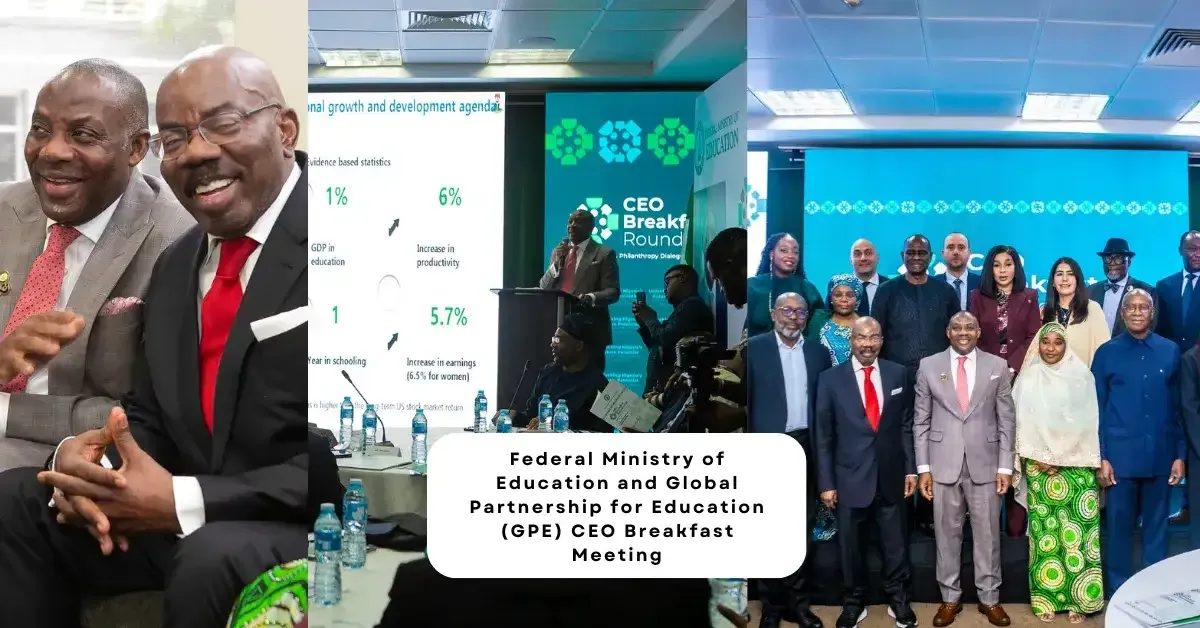
Nigeria's Education Minister has revealed that the Federal Government is positioning the country to receive an additional $500 million from a proposed $11.5 billion global education fund, as part of a broader financing push that includes ₦100 billion earmarked for new student hostels across universities and polytechnics.
Minister of Education Dr Tunji Alausa disclosed at a Federal Ministry of Education and Global Partnership for Education (GPE) CEO Breakfast Meeting held in Lagos, where private sector leaders and development partners gathered to align investments with the government's reform agenda.
"As part of this conference cycle, if everything goes well, Nigeria will benefit from another $500 million to support our foundational education," he said, describing the global replenishment initiative as a major opportunity to deepen ongoing reforms across 80 participating countries.
On Tertiary Education, Alausa said the government would spend approximately ₦100 billion this year constructing new Student Hostels in Universities and Polytechnics, alongside the rehabilitation of Engineering Workshops, Medical schools and Technical Institutions. "We are investing heavily in STEM and technical education because that is where the future lies," he said.
The Minister also presented a sobering account of where Nigeria's education system currently stands. Despite reintegrating over 1.1 million out of school children into classrooms in the past 24 months, approximately 15 million children remain out of school, with heavy concentrations in the North East and North West. A further structural crisis exists between primary and junior secondary education: while 32 million children attend primary school, only around six million are enrolled at the junior secondary level, a drop of approximately 22 million. The Minister attributed the disparity directly to infrastructure, noting that Nigeria has roughly 78,000 primary schools but only 9,000 junior secondary schools.
On basic education financing, Alausa said reforms had unlocked over ₦140 billion of the nearly ₦240 billion that had been sitting as unaccessed UBEC matching grants before the current administration. The Government is also pursuing a bill to increase UBEC funding from 2% to 4% of the applicable budget. A nationwide digital tracking platform has been deployed for the first time to follow students across their educational journey and enable earlier intervention when dropouts occur.
Minister of State for Education Professor Suwaiba Said Ahmad stressed that government funding alone cannot meet the scale of investment required. "The private sector remains a critical partner in driving innovation, expanding infrastructure, and ensuring that our education system produces globally competitive graduates," she said.
For students in Nigerian Universities and Polytechnics, the ₦100 billion hostel commitment is the most immediate of the announcements, addressing a chronic accommodation crisis that forces thousands of undergraduates into costly and distant off campus housing each year.
Leave a Reply