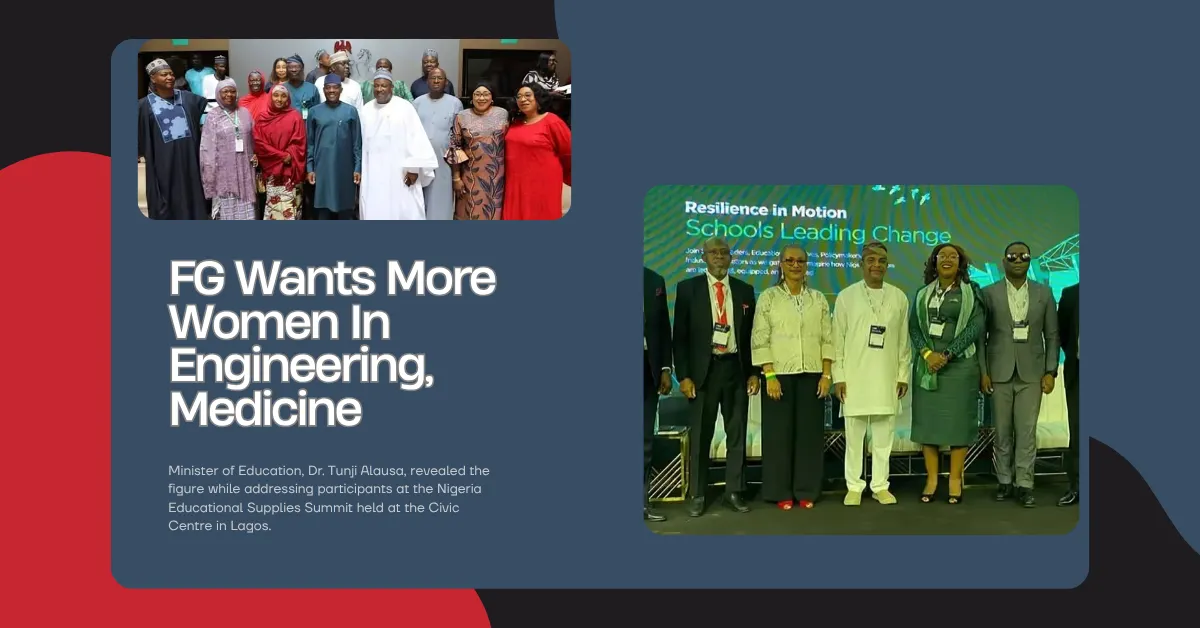
The Federal Government has disclosed that only 35% of female students currently pursue studies in Science, Technology, Engineering, Mathematics and Medicine, warning that the stagnant figure threatens Nigeria's supply of female engineers, doctors and researchers at the tertiary level and beyond into the workforce.
Minister of Education, Dr. Tunji Alausa, revealed the figure while addressing participants at the Nigeria Educational Supplies Summit held at the Civic Centre in Lagos. Represented by his Special Adviser on STEMM and Corporate Sector Engagement, Dr. Adetola Salau, the Minister stressed that increasing girls' participation in STEMM has become a national priority under the Nigeria Education Sector Renewal Initiative, with implications for the pipeline of female professionals entering universities and, eventually, Nigeria's technical and medical workforce.
Alausa maintained that expanding opportunities for girls in science and technology education is essential to building a future ready workforce capable of driving innovation, industrialisation and sustainable national development. He noted that early exposure at school level directly determines how many girls go on to study engineering, medicine and related disciplines at university, and ultimately how many enter Nigeria's scientific and technical labour force.
He called on schools nationwide to create inclusive learning environments where girls are encouraged to participate actively in science experiments, technology clubs, coding programmes and engineering projects from an early age, describing this groundwork as essential preparation for tertiary level STEMM study. He also advocated stronger mentorship programmes connecting successful female scientists, engineers and technology professionals with young girls in schools, arguing that visible role models already working in engineering and medicine would encourage more girls to pursue and complete degrees in those fields.
The Minister urged education administrators not to allow inadequate facilities to prevent effective science teaching, explaining that innovation often begins with creativity rather than expensive equipment. He recalled using simple classroom materials such as bottle tops, cups and brooms to teach engineering design during one of his STEM programmes.
Alausa further disclosed that the Federal Ministry of Education is implementing several STEMM initiatives closely linked with Technical and Vocational Education and Training, aimed at equipping learners with practical skills that meet the demands of modern industries, including engineering and healthcare sectors currently underrepresented by women.
Speaking at the summit, Lagos State Commissioner for Basic and Secondary Education, Jamiu Ali Balogun, underscored the importance of collaboration in strengthening Nigeria's education system, stating that meaningful reforms require sustained partnerships between governments, private organisations, development partners and other stakeholders.
Education experts at the summit observed that increasing female participation in STEMM would expand Nigeria's pool of female engineers, doctors, researchers and technology entrepreneurs at the tertiary and professional levels, strengthening national competitiveness and accelerating the country's technological and economic transformation.



Leave a Reply