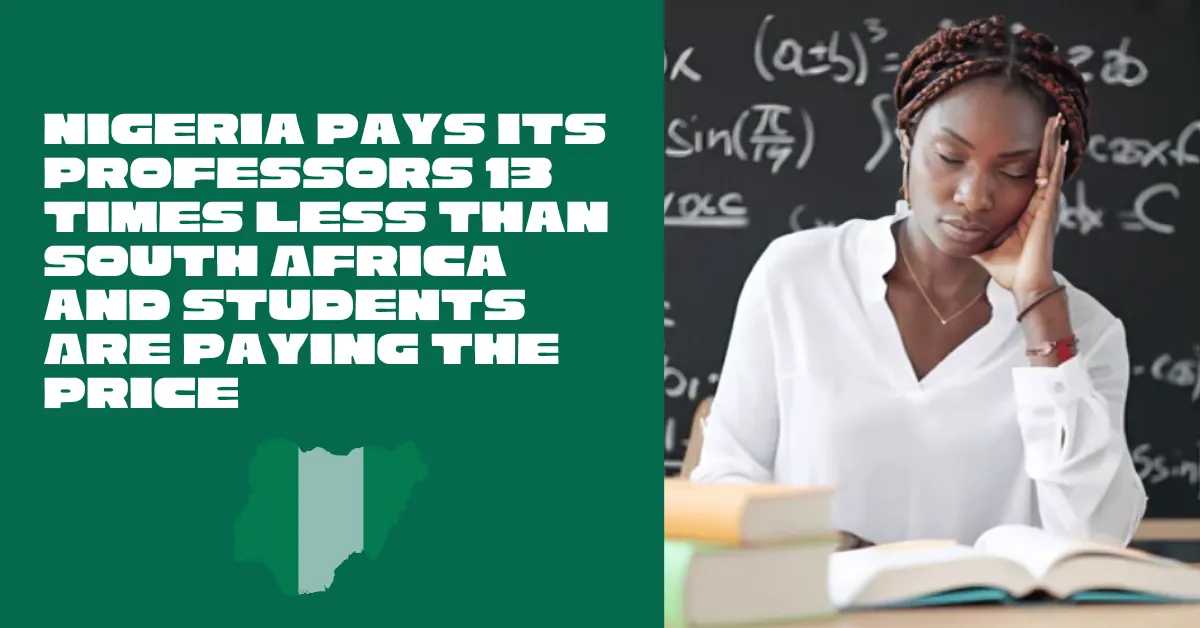
Nigerian University students are receiving a lower quality of education partly because their Lecturers are among the worst paid on the African continent, and experts warn that the situation is getting worse rather than better.
Data on salaries of Professors with less than ten years in the Professorial cadre across African Public Universities shows that a Nigerian professor earns approximately $4,400 annually, equivalent to roughly ₦500,000 per month. A South African professor in the same bracket earns $57,471 per year, more than 13 times higher. Kenyan professors earn $48,000 annually, while those in Gabon, Seychelles, and Ghana earn $29,907, $13,950, and $12,960, respectively.
At the lower end of the scale, salary data from the University of Ibadan indicates that an Assistant Lecturer in Nigeria earns a minimum of ₦794,260 annually. A Senior Lecturer earns between ₦1.65 million and ₦2.35 million per year, figures that experts say bear no relationship to the current cost of living in any Nigerian city.
Kayode Soremekun, former Vice Chancellor of the Federal University, Oye Ekiti, said the underpayment is directly driving emigration. "The average lecturer is on the lookout perpetually for opportunities abroad. The government should tackle the problem frontally and examine what obtains in countries such as South Africa and match the same, or even go beyond it. Otherwise, we will be caught in this morass for a long time," he said.
Stanley Alaubi, a Senior Lecturer at the University of Port Harcourt, connected the salary crisis directly to what students experience in the classroom. A lecturer under financial pressure, he argued, cannot give full attention to teaching, research, and student mentoring. "The purchasing power should actually be that which can take lecturers home, and a take home pay should actually take one home," he said, adding that the government must honour the 2009 agreement signed with ASUU.
Jessica Osuere, Chief Executive of RubiesHub Educational Services, said poor remuneration forces Lecturers into multiple jobs, reducing the time available for teaching, supervision, and student feedback. "This ultimately weakens instructional quality and students' learning outcomes," she said. She described Nigeria's salary framework, including the CONUASS structure, as outdated, and called for pay reviews tied to performance and research output alongside improved University funding.
Nubi Achebo, Director of Academic Planning at the Nigerian University of Technology and Management, said the root cause is structural overdependence on government funding combined with consistently low budget allocations to education. He called for public private partnerships, alumni fundraising initiatives, and policy reform to provide Universities with alternative revenue streams.
For students currently enrolled in Nigerian Universities, the implications are that every lecture delivered by a distracted, financially stretched, or soon to depart academic is a lecture that falls short of what a properly remunerated system would produce.



Leave a Reply