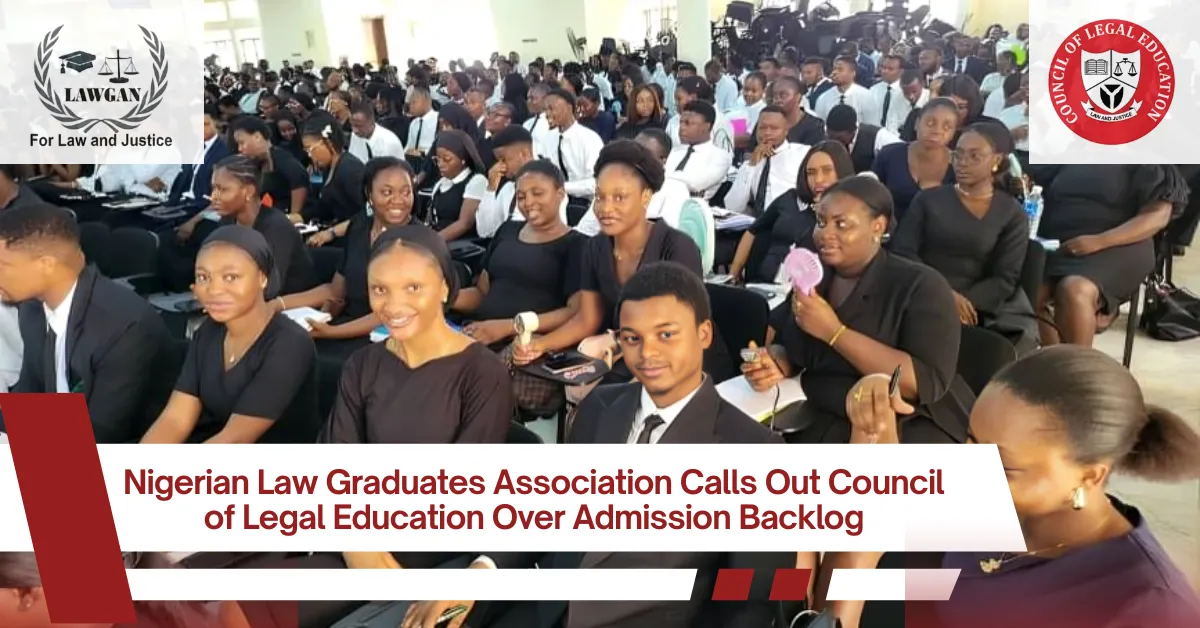
Hundreds of Nigerian law graduates remain unable to begin their professional training despite completing accredited degree programmes, a situation that a national advocacy group says has gone on for far too long.
The Law Graduates' Association of Nigeria, LAWGAN, issued a press release on Thursday calling on the Council of Legal Education to resolve what it described as years of unjust exclusion affecting graduates of the National Open University of Nigeria's Faculty of Law, as well as those from Abia State University and other institutions caught in an administrative backlog. The statement, signed by President Kayode Bello and Public Relations Officer Ojo Clement, was timed ahead of the resumption of a new Nigerian Law School academic session in March 2026.
According to LAWGAN, NOUN law graduates have for years faced "uncertainty and exclusion" from admission into the Nigerian Law School despite having studied at a recognised and accredited institution. Separately, ABSU graduates and others have been held back by administrative and accreditation related difficulties that the Council has yet to fully resolve.
The association was pointed in its language. "LAWGAN respectfully submits that these graduates, having fulfilled their academic requirements from duly recognized institutions, deserve equitable access to vocational legal training in line with constitutional principles of fairness, equality, and the right to education," the statement read.
Its demands were equally specific. The Council of Legal Education was asked to clarify the admission status and pathway for NOUN graduates, move quickly to clear the ABSU backlog, and commit to a transparent timeline for resolving all outstanding cases. LAWGAN also called on the Federal Ministry of Justice and the Office of the Attorney General of the Federation to step in and bring relevant parties to the table.
The association acknowledged the efforts of Attorney General Lateef Fagbemi (SAN) in advancing the cause of NOUN graduates, but made clear that acknowledgement alone was not enough. "The continued delay in resolving these issues risks undermining confidence in the legal education system and unfairly penalizes graduates who have invested significant time, resources, and effort in pursuit of their legal careers," it warned.
For the graduates at the centre of this dispute, the stakes could hardly be more personal. Every session that passes without resolution is another year lost from a legal career that their academic qualifications say they have already earned the right to begin.


Leave a Reply