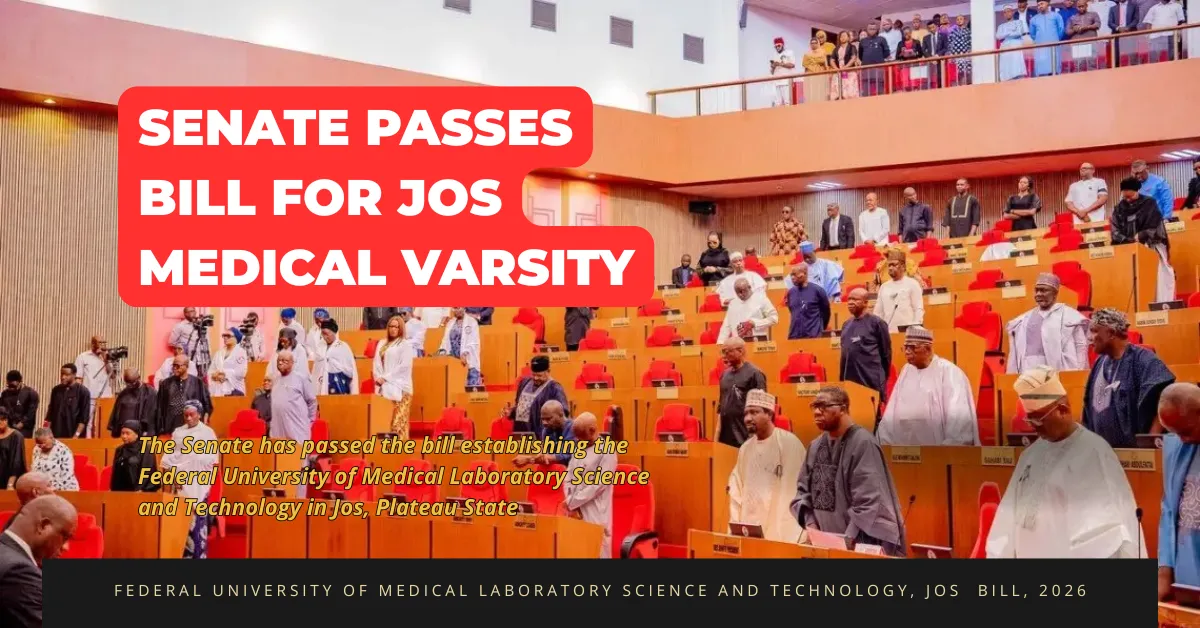
The Senate has passed the bill establishing the Federal University of Medical Laboratory Science and Technology in Jos, Plateau State, a move expected to strengthen Nigeria's diagnostic capacity, improve healthcare delivery, and reduce dependence on medical treatment abroad. The bill, which originated in the House of Representatives, received the concurrence of the Senate during plenary on Tuesday after lawmakers unanimously approved it while sitting as the Committee of the Whole, presided over by Deputy Senate President Barau Jibrin.
According to a copy of the bill obtained by correspondents on Wednesday, the proposed University is expected to serve as a specialised institution for training medical laboratory scientists, advancing biomedical research and innovation, and producing skilled manpower to improve disease diagnosis and strengthen Nigeria's health security. Presenting the legislation, Senate Leader Opeyemi Bamidele urged lawmakers to support the measure, alongside two other bills, describing them as important interventions in the country's health and education sectors.
The Senate subsequently approved the Federal Road Safety Corps Amendment Bill, 2026, the Federal University of Medical Laboratory Science and Technology, Jos Establishment Bill, 2026, and the Federal Universities of Technology Amendment Bill, 2026. The upper chamber also passed for second reading a bill seeking to amend the Federal Medical Centres Act to establish a Federal Medical Centre in Argungu, Kebbi State.
Reacting to the Senate's approval, the Provost and Chief Executive Officer of the Federal College of Medical Laboratory Science and Technology, Jos, Prof Sunday Etukudoh, described the development as a landmark for Nigeria's healthcare system. "COVID 19 stripped us bare and whispered a truth we must never forget: A nation that cannot diagnose cannot defend itself," he remarked, adding that the passage was "not bureaucracy. It is prophecy."
Etukudoh urged the Federal Government to prioritise the Institution's takeoff, stating that Nigeria's health security, youth destiny, and scientific independence hang in the balance. Highlighting its preparedness, he noted that the permanent site already boasts an ultra modern auditorium, two storey administrative and classroom buildings, an electronic library, and state of the art diagnostic and research laboratories, though he lamented the absence of student accommodation. "A university without hostels is a body without a heart," he explained.
The Federal College of Medical Laboratory Science and Technology, Jos, traces its origins to a training unit created in 1954 under Nigeria's Hospital Services before becoming a full fledged federal college in 2006. Health stakeholders believe the new University will build indigenous expertise and reduce the billions of dollars Nigeria loses annually to outbound medical tourism.


Leave a Reply