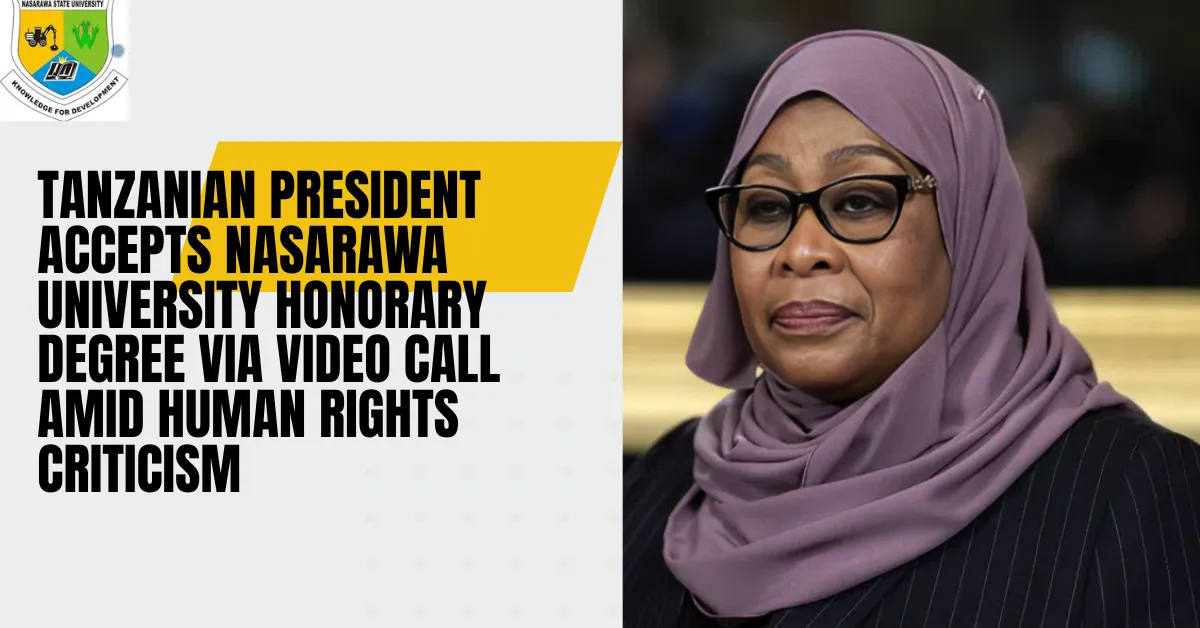
When Nasarawa State University announced that Tanzanian President Samia Suluhu Hassan would receive an honorary doctorate at its 25th anniversary convocation in Keffi, the plan was for a high profile in person ceremony. What took place instead was a virtual acceptance, a conspicuous absence, and a fresh national conversation about whether Nigerian Universities are asking the right questions before conferring their highest ceremonial honours.
Hassan, who won Tanzania's October 2025 presidential election by a landslide, cancelled her planned trip to Nigeria and joined the ceremony remotely. The decision came amid mounting international scrutiny of her administration's response to post election protests in Tanzania, where human rights organisations have accused security forces of opening fire on demonstrators, carrying out widespread arrests and, according to some activist accounts, taking victims to morgues and burying others in suspected mass graves near Dar es Salaam. The Tanzanian government has rejected these allegations, stating that security forces acted to maintain law and order during the unrest.
The timing placed Nasarawa State University in an uncomfortable position. Rather than withdraw the award, the Institution proceeded with the ceremony, accepting Hassan's virtual participation as a substitute for the in person visit. Her absence from Nigeria is widely interpreted as a calculated decision to avoid protests or media attention that could have disrupted the event or amplified the human rights narrative around her visit.
The episode drew additional scrutiny because it arrived shortly after the National Universities Commission issued new guidelines warning Nigerian universities against the indiscriminate conferment of honorary degrees on political figures and public officials. The NUC's guidelines specifically bar serving elected and appointed officials from receiving such awards, a provision that the Nasarawa State University ceremony appeared to sit uncomfortably alongside.
For Nigerian universities watching this episode unfold, the question it poses is direct: at a time when the NUC is tightening the rules around honorary degrees and the global spotlight on governance is brighter than ever, what does it cost an Institution's reputation to proceed with a contentious honour when the weight of criticism is already visible before the ceremony begins?

Leave a Reply