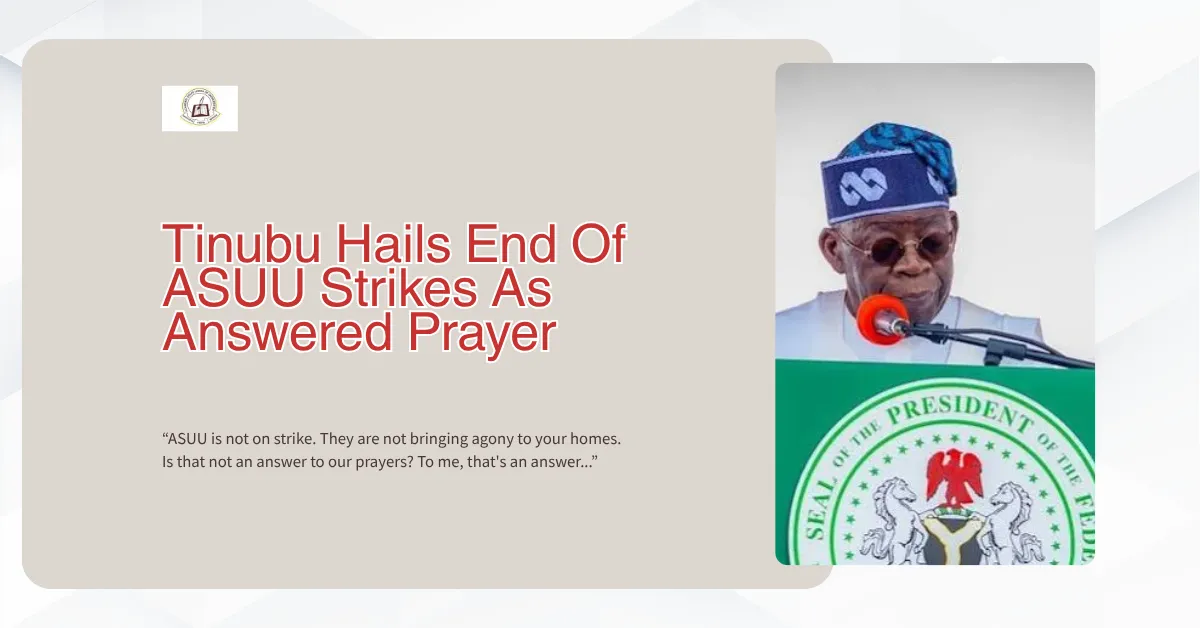
President Bola Tinubu has described the absence of strikes by the Academic Staff Union of Universities under his administration as an answer to his prayers, crediting it as one of the measurable improvements in the lives of Nigerian families.
Tinubu made the remarks in Abuja on Tuesday while receiving members of the Catholic Bishops' Conference of Nigeria at the Aso Rock Presidential Villa.
“ASUU is not on strike. They are not bringing agony to your homes. Is that not an answer to our prayers? To me, that's an answer,” he stated.
The President noted that no prolonged ASUU strike had been recorded since he assumed office in May 2023, a period that has also coincided with the launch of the NELFUND scheme.
Addressing the clergymen directly, Tinubu remarked, “None of your children in university today, and I would say they are all your children because you are Reverend Fathers, can say a four year course is not four years.”
His comments come against the backdrop of ASUU's long history of industrial action in Nigeria's public universities. Between 1999 and 2022, the union embarked on strikes totalling more than five years of lost academic time, with the longest in its history lasting nine months in 2022.
Beyond education, Tinubu acknowledged the economic hardship Nigerians had faced under his administration but insisted that stability was taking hold. “I inherited the assets and liabilities of my predecessor, and I've been running with it. But this government has stabilised, and there is prosperity on the horizon. The quality of life is improving,” he explained.
On security, the President added, “The security situation is what it is. We don't have another country but here. This Nigeria. And we revert to our national anthem, in its complexity, diversity, we shall thrive, rejoice, and be good to all of us.”
The Catholic Bishops' Conference of Nigeria, founded in 1956, remains one of the country's most influential religious bodies, with significant reach in education, healthcare, and social services across the predominantly Christian south and several northern states.


Leave a Reply