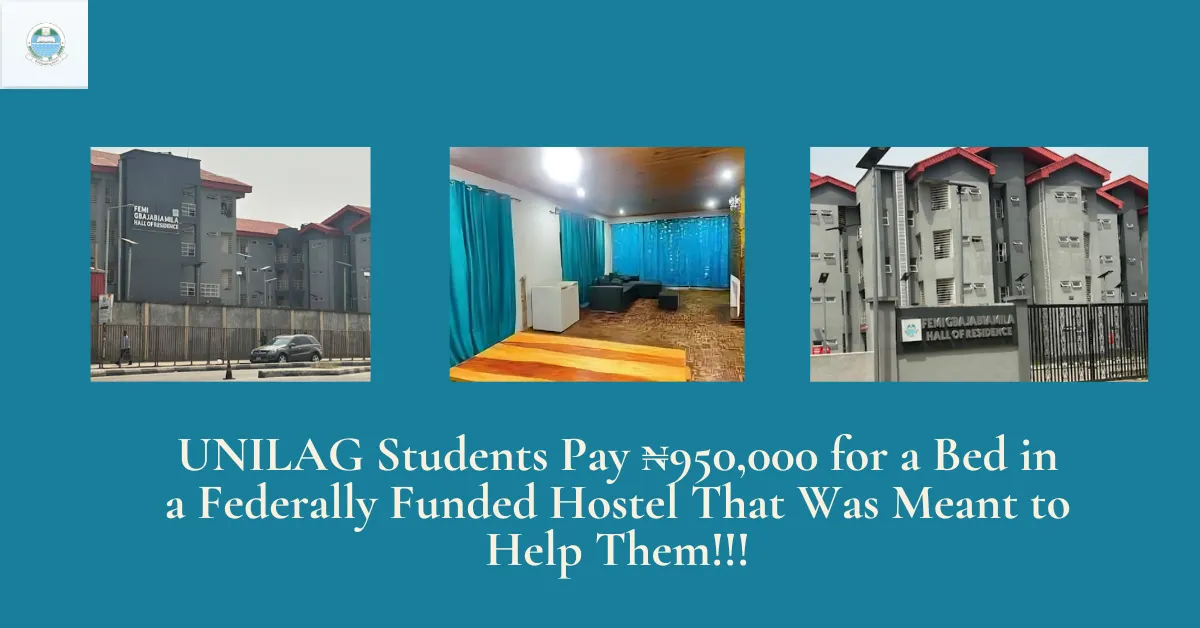
A Federal Government Hostel built with ₦1.6 billion of public funds, to ease the accommodation crisis at the University of Lagos, is charging students nearly ₦1 million per bed space, placing it at the same price point as the Private Hostels it was supposed to offer an alternative to.
The Femi Gbajabiamila Hall of Residence, constructed under the Zonal Intervention Project (ZIP) Appropriation Act of 2020 and commissioned on the 3rd of January 2024, has 484 bed spaces priced at ₦710,000 for a four man room and ₦950,000 for a single occupancy room per session. By comparison, students in older University Managed Hostels such as King Jaja Hall and Mariere Hall pay ₦80,000 for a bed space.
The accommodation crisis at UNILAG predates the hostel. The University has a student population of approximately 52,000 and admits around 9,000 students annually, but its halls of residence provide fewer than 8,000 bed spaces in total. Students who miss out on balloting for on campus spaces are pushed into the surrounding communities of Akoka, Bariga and beyond, where landlords charge between ₦450,000 and ₦700,000 for a shared room.
Chinedu Obote, a first year Economics student from Enugu, ended up in Egbeda, 25 kilometres from campus, after failing to secure a hostel place. He wakes at 5 a.m. daily for a commute that takes between 90 minutes and two hours each way. "I spend roughly ₦8,000 on transport every day. Sometimes, all I'm thinking about is not even reading but how to manage transport for the week," he said.
Williams Motunrayo, a 400 level Physics student, pays ₦700,000 for a bed space in a room shared with five others. Her annual tuition is ₦220,000. "How is it possible that rent is more than what I pay for school fees?" she said. Damilare Ibiyemi, who also pays ₦700,000 for a shared room, said hostel payments take priority over tuition because landlords replace non paying students immediately.
The Gbajabiamila hall, which UNILAG classifies alongside private hostels in its balloting notices, could generate approximately ₦300 million annually at full occupancy. Federal budgets for 2024 allocated a further ₦247,963,258.79 and ₦250,000,000 for the maintenance of the facility, meaning public funds continue to flow into a project generating commercial returns.
Public finance advocate, Deborah Folorunsho, said that pricing publicly funded infrastructure at market rates raises fundamental questions. "When infrastructure built with public funds is priced at market or near market rates, it raises fundamental questions about equity and intent," she said.
Yinka Otuduyo of BudgIT noted that constituency projects are not the personal property of the lawmakers who nominate them. "The funds are from taxpayers, but the naming makes it seem like a gift from a politician," he said, adding that naming public projects after facilitators blurs accountability.
A UNILAG communications official said hostel fees are determined by management based on maintenance costs and operational expenses, and that the amenities at the Gbajabiamila hall justify its pricing. The Dean of Student Affairs did not respond to calls, and Femi Gbajabiamila's office had not responded to enquiries at the time of publication.
For the students, it was built to help, but the hostel has become another data point in an accommodation market that continues to price them out.


Leave a Reply