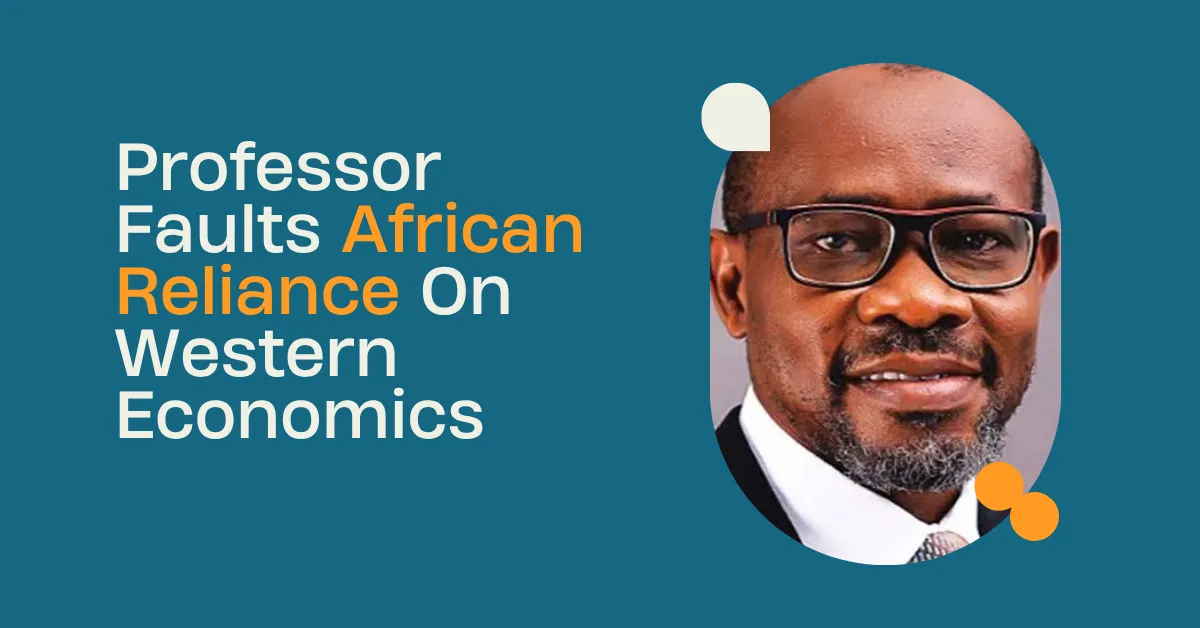
A Professor of Economics at the Lagos Business School, Bongo Adi, has urged African scholars to develop original economic theories drawn from the continent's own realities rather than continuing to rely on frameworks formulated in Europe and the United States, a call with direct implications for how economics is taught and researched in Nigerian universities.
Adi made the case while delivering Pan Atlantic University's 23rd inaugural lecture, titled "The End of Development Economics: A Manifesto for Post Industrial Policy," at its Lekki campus in Lagos. He argued that African economists have long been confined to generating data while scholars in developed countries formulate the theories used to interpret it, an imbalance he said shapes how economics students on the continent are trained and how their research is judged.
"For too long, African economists have been required to justify their work by reference to frameworks developed elsewhere, to benchmark their economies against trajectories established by other countries, and to apologise for how African realities deviate from Western models," he stated.
Adi called on Nigerian and other African academics to move beyond fitting local realities into externally developed frameworks and instead produce theories reflecting the continent's own socioeconomic context, describing the shift as an opportunity rather than a loss. "The end of development economics is not a cause for mourning, it is for liberation," he said.
He challenged the next generation of scholars, including students currently in Nigerian economics and development studies programmes, to replace rather than merely refine existing development paradigms, combining intellectual ambition with practical policy solutions. Adi noted that artificial intelligence and mechanisation are reshaping the global economy in ways not captured by inherited theoretical models, pointing to entrepreneurs, engineers and creative workers across Africa building economic futures that no existing textbook predicted.
The lecture, delivered as part of the University's inaugural lecture series, forms part of a broader push within Nigerian academic circles to reassess how economics and development policy are taught, with implications for curriculum design, postgraduate research direction and policy training for students entering public and private sector economic roles.

Leave a Reply